Porsche Ditches the VW Emissions Pool and Pays China's Xpeng for CO2 Credits
By DianMa Auto · 2026-08-12 · Industry
Porsche has left the family pool. According to Schmidt Automotive Research, a filing submitted to the European Commission on August 5 confirms the sports car maker has exited the Volkswagen Group CO2 pool and will instead average its fleet emissions with Xpeng across 2026 and 2027. Other manufacturers can apply to join the open pool until September 5.
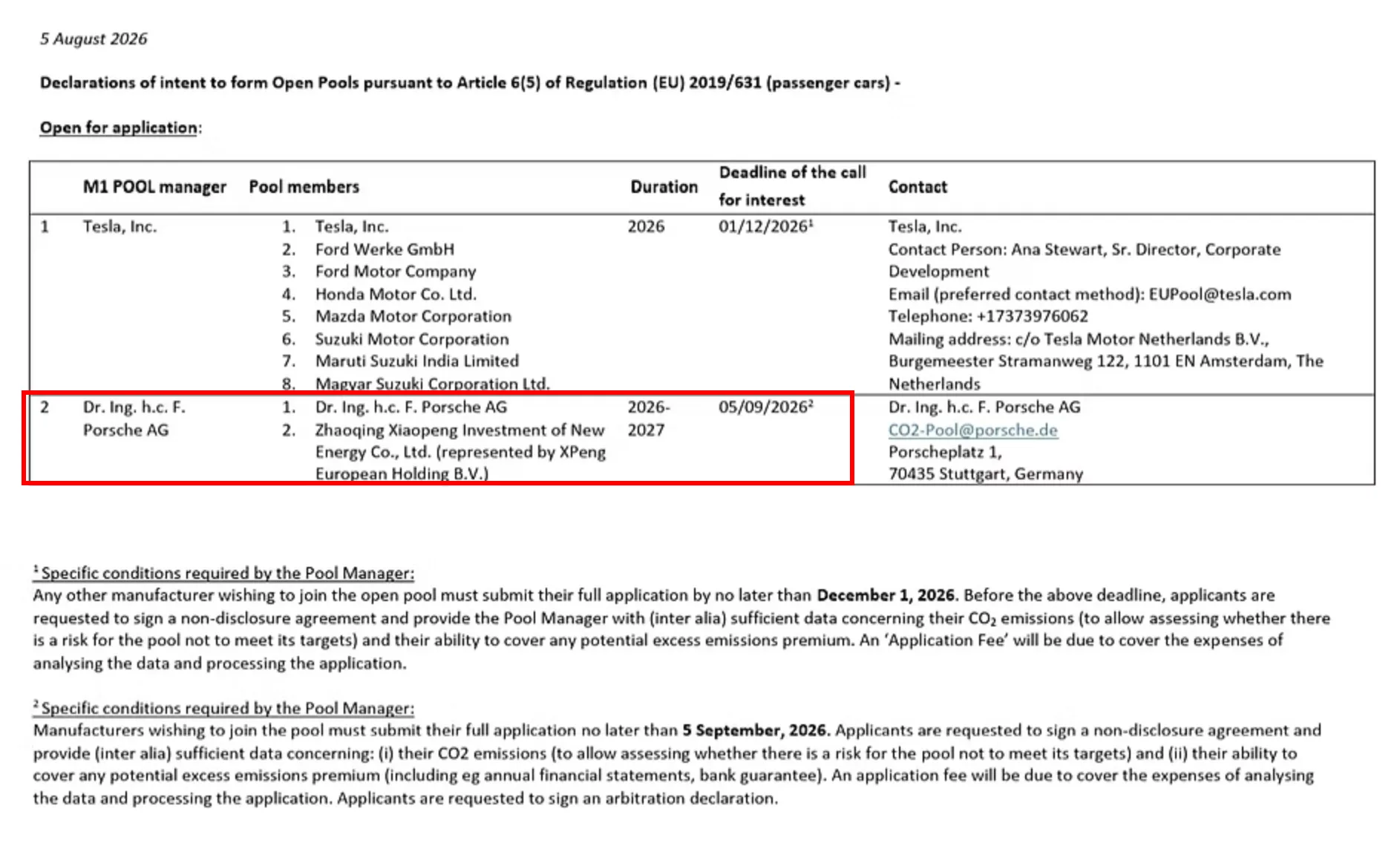 The EU pooling mechanism lets multiple automakers merge their fleet averages, so companies selling lots of EVs can sell surplus credits to high-emitting allies. Rules in force since 2025 require a fleet average of 93.6 grams of CO2 per kilometer, with fines of 95 euros (about $110) per excess gram per vehicle, and industry-wide penalties could reach 15 billion euros (about $17.3 billion). Brussels has allowed three-year averaging since 2025, but the target itself has not moved.
Porsche's exit traces back to its own stalling electrification, with its Western European BEV sales down about 30 percent in the first half of 2026 and the BEV share of its regional volume falling from nearly 40 percent to 30 percent, while the returning combustion Macan will push the average higher still. Volkswagen Group missed the target at roughly 100 grams per kilometer in 2025, and shedding its high-emitting subsidiary actually improves its odds of squeezing through. The divorce works for both sides.
The choice of Xpeng is no accident, since Volkswagen paid 700 million euros (about $810 million) for a 4.99 percent stake back in 2023 and cooperation has since extended from vehicle platforms to electronic architecture. Xpeng delivered nearly 20,000 cars in Western Europe in the first half and could approach 50,000 this year, overtaking Polestar as the region's top Chinese premium brand, and its all-electric L03, G6, G9 and P7+ lineup makes it a ready-made credit supplier.
Buying credits is standard practice in Europe, with Tesla's pool now counting Ford, Honda, Mazda and Suzuki among its members, Mercedes teamed with Volvo, Polestar and Smart, and Stellantis pooling separately with its investee Leapmotor. Some sobriety is warranted, since Xpeng's half-year volume is still small by European standards and this credit income depends entirely on EU policy holding steady, on a business model Tesla pioneered more than a decade ago. Even so, the sight of a German sports car icon paying a Chinese startup for compliance tells you where the industry's center of gravity is drifting.