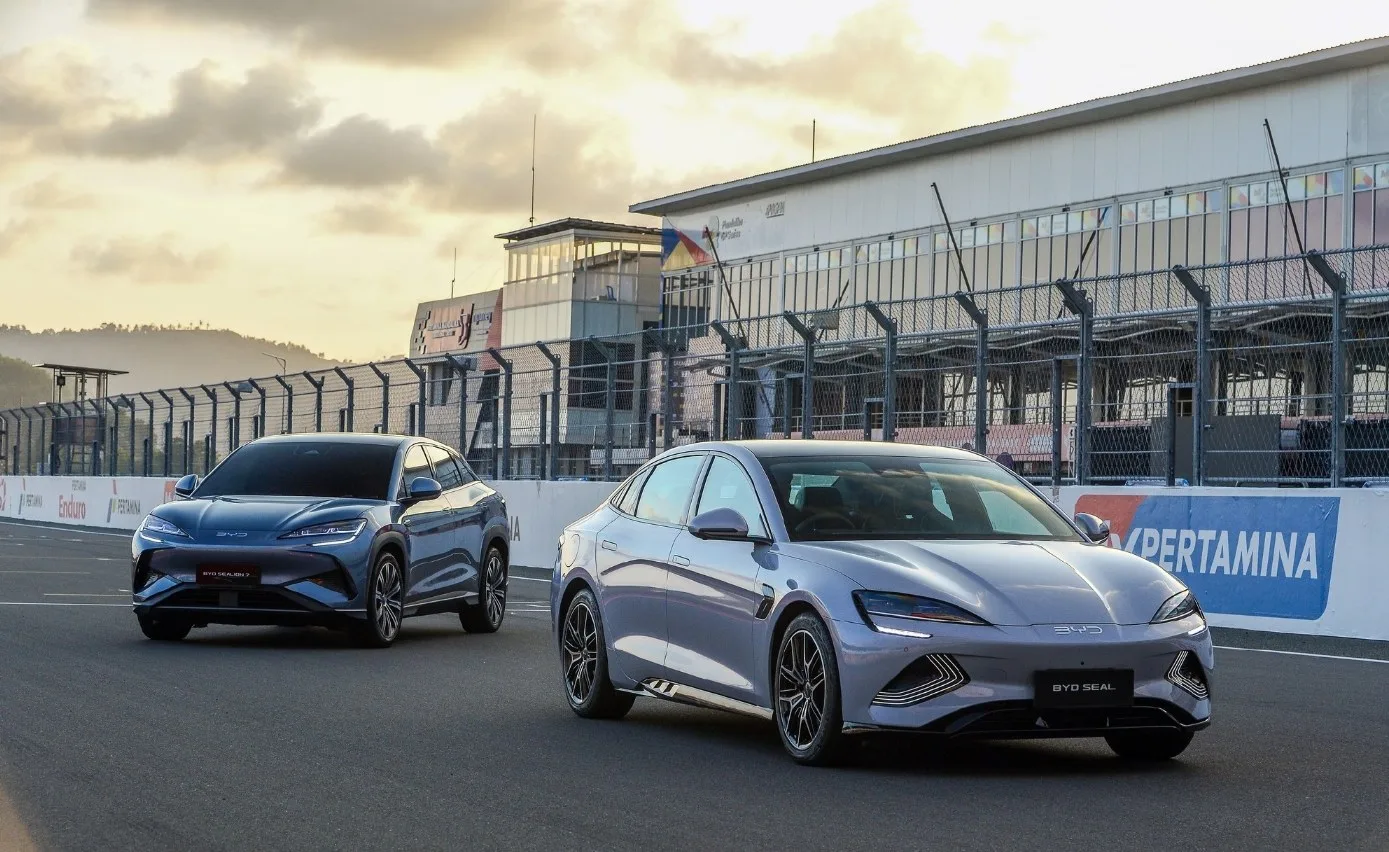
China's global car share just fell 3.3 points, even as BYD climbed to No. 5 worldwide
By DianMa Auto · 2026-11-03 · News
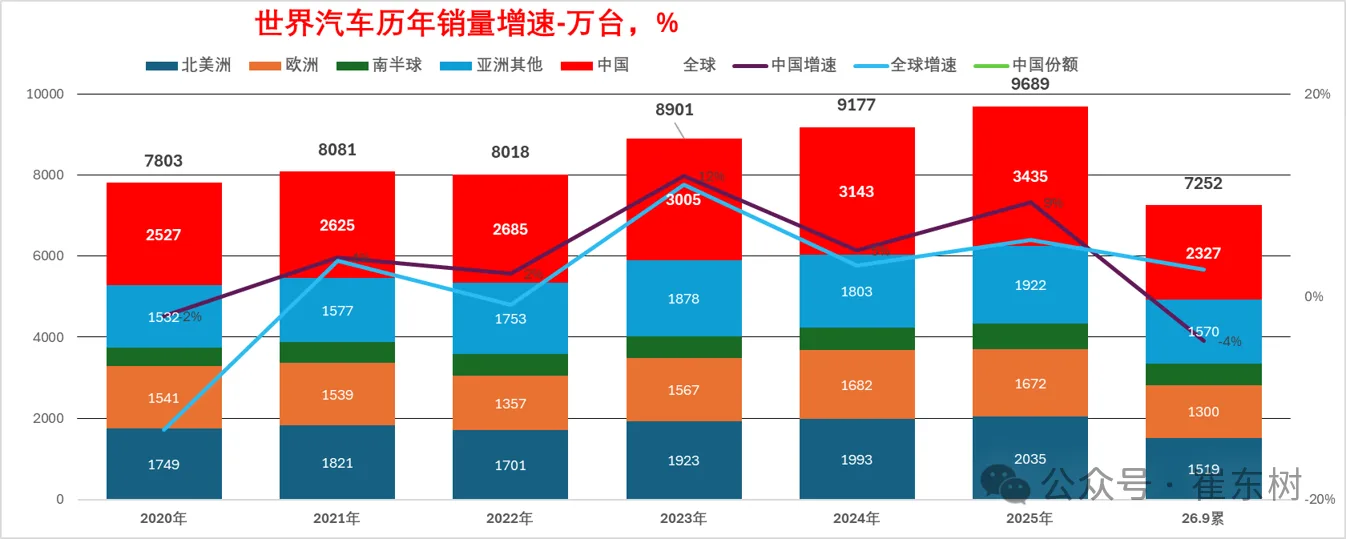
For six straight years China's slice of the world car market moved in only one direction, and 2026 is the year that stopped. Data published on November 2 by Cui Dongshu, secretary general of the China Passenger Car Association, puts global vehicle sales at 72.52 million units in the first nine months of 2026, up 3 percent year on year, with China accounting for 23.27 million of them and a 32.1 percent share, down from 35.4 percent in 2025 and the first real retreat since 2019.
 That headline and what happened on Chinese forecourts are two very different numbers, since the 23.27 million figure tracks wholesale volume that includes vehicles built for export, and the retail picture underneath it is far weaker. CPCA data shows passenger car retail sales of 13.33 million units over the same nine months, down 21.7 percent, with September alone at 1.618 million, down 28 percent, a drop severe enough to knock the world's largest market off its stride and drag the global growth rate from 6 percent in 2025 down to 3 percent.
Subsidy timing explains much of the swing, since China's trade-in and scrappage programmes drove a 9 percent sales gain in 2025 and pushed the country to a record 35.4 percent share, and then the 2026 round started slowly, January ran strong on pre-holiday buying, February fell apart when the Spring Festival landed mid-month, and March through July recovered before August slipped again and September climbed to the second highest month of the year, lifting China's monthly share back to roughly 35 percent while the cumulative figure stayed at 32 percent.
The longer curve matters more than any single month, given that China's share ran around 30 percent from 2016 to 2018, slipped to 29 percent in 2019, recovered to 32 percent in 2020 and 2021, then climbed to 33.5 percent in 2022, 33.8 percent in 2023, 34.2 percent in 2024 and a peak of 35.4 percent in 2025, which makes the 32.1 percent reading less a reversal of the trend than a reset after a policy-driven spike.
The quarterly totals follow the same rhythm without the noise, at 22.89 million in the first quarter, 24.83 million in the second and 24.71 million in the third, while the global curve has flattened hard, from 11 percent growth in 2023 to 3 percent in 2024, back to 6 percent in 2025 and 3 percent again so far this year.
September added 8.74 million units, up 2 percent year on year and 12.4 percent on August, and the fact that a 2 percent month counts as the second strongest of the year says plenty about how soft the middle of 2026 was.
The regional split is more lopsided than most Western coverage suggests. Strip China out of the 72.52 million total and the remaining 49.25 million divides into 15.19 million in North America, 13.0 million in Europe, 15.70 million across the rest of Asia and 5.37 million in the southern hemisphere, which means Asia outside China now outsells all of North America and that Europe, the market everyone benchmarks against, is the smallest of the three big blocs.
Growth came from the places that rarely make the front page, with India lifting its share to 6.7 percent, roughly 4.9 million vehicles, on a 22 percent jump, Thailand up 16 percent, Vietnam up 27 percent and Russia up 5 percent, gains that were just enough to offset a 2 percent decline in the United States, where 12.30 million units translated to a 17.0 percent share that keeps eroding a little each year.
None of which means Chinese automakers are retreating, and this is the part that deserves more attention than the share number itself. Three Chinese groups now sit inside the global top ten, with BYD back at fifth, Geely seventh and Chery eighth, a ranking that would have read like a typesetting error a decade ago.
The United States is the odd one out in all of this, since its 12.30 million units and 17.0 percent share came with Chinese brands effectively locked out by tariffs and software rules, which means the competitive pressure showing up in Bangkok, Melbourne and Mexico City is not yet visible in American showrooms and will not be for as long as current policy holds.
Exports are what filled the hole left by the domestic slump. China shipped 8.63 million vehicles abroad in the first nine months, up 52 percent, with September alone at 1.182 million, up 55 percent year on year and 13 percent on August, and export value reached 149.8 billion dollars, up 54 percent, which puts the average export at about 17,400 dollars a car, means overseas shipments now equal roughly 37 percent of the domestic market, and points to a full year around 12 million against 8.32 million in 2025.
Those shipments are also landing further from the emerging markets that used to absorb them. September's top destinations were Russia at 112,962 units, the UK at 58,740, Brazil at 58,725, Australia at 46,559, Belgium at 45,369, Thailand at 39,323, the UAE at 39,120, Mexico at 38,962, Italy at 37,731 and Spain at 34,051, so five of the ten are developed economies and four are in Europe, a very different map from the one drawn three years ago.
Electrification is carrying those exports, with 612,000 new energy vehicles shipped abroad in September alone, up 104 percent, while at home the new energy share of new car sales reached 61.6 percent that month and passenger car retail penetration hit 67.0 percent, so a market that is shrinking overall is still converting to electric faster than any other large market on earth.
The money tells the harder truth, since China's auto industry booked 8.04 trillion yuan (about 1.21 trillion dollars) of revenue in the first nine months, up 2.6 percent, against costs up 3.8 percent, leaving profit of 267.5 billion yuan (about 40.2 billion dollars), down 23 percent and a margin of just 3.3 percent, and September was worse still, with 14.2 billion yuan (about 2.13 billion dollars) of profit down 68 percent on a 1.4 percent margin, the weakest in about four years, which works out to roughly 4,600 yuan (about 690 dollars) of profit per vehicle built.
That margin is the number North American readers should sit with, because a 3.3 percent return on 8.04 trillion yuan of revenue leaves almost nothing for research, dealer networks or the discounts that keep volume moving, and a home market that cannot pay for itself is exactly the condition that pushes automakers to export harder, which makes the falling share and the record export run two halves of one decision rather than a contradiction.
The losers in this reshuffle are mostly European, since Renault-Nissan, Stellantis and Volkswagen have together given up about 3 points of global share since 2019, roughly 3 million vehicles of annual volume, and Cui argues that pulling out of China is not an option and that these companies need what he calls a second startup, because protecting margin in Europe while ceding the world's largest market has not rescued anyone yet.
The survivors kept either a fortress home market or a product line that still fits local buyers. Toyota held around 11 percent, just 0.8 points below its 2019 level, Hyundai sat at 7.4 percent, down 0.2 points, and Suzuki and Tata gained on the strength of India, while Honda dropped 2.5 points on a weak China performance and now stands as the clearest example of what happens when neither condition holds.
One caveat belongs on the record, because the global totals come from the 70 countries that report monthly, roughly 90 million units in a normal year, with another hundred or so countries adding about 3 million on an annual basis, so these share figures are stable rather than precise and moves of a few tenths of a point in a single month should be read as noise rather than signal.
Read together, the numbers describe something easier to misread than to explain. China's share of the world market fell because Chinese buyers bought fewer cars at home, not because Chinese cars got worse, and the same nine months delivered the country's strongest export run on record, three brands inside the global top ten and a domestic market converting to electric at 67 percent, so the pressure that used to sit in Chinese showrooms is now arriving in showrooms from Jakarta to Johannesburg to Mexico City, and the 32.1 percent figure is less a verdict on Chinese cars than a receipt for what Chinese subsidies did in 2025 and stopped doing in 2026.