China takes the world car factory title from Japan! Exports hit 7.153 million in January-August, over 33,000 vehicles shipped daily
By DianMa Auto · 2026-09-20 · Industry
Latest data from the China Association of Automobile Manufacturers (CAAM) shows China exported 7.153 million complete vehicles in January-August 2026, up 66.7 percent year on year, far exceeding Japan's roughly 2.4 million in the same period and already surpassing China's full-year 2025 total of 7.098 million. Eight months did the work of a whole year, and China's momentum in holding the world car factory title has turned from trend into fact.
Specifically, in August 2026 alone China exported 1.01 million vehicles, up 65.3 percent year on year and down slightly 3.2 percent from the previous month, the third straight month above the million mark. In other words, over the past three months more than 33,000 Chinese cars were shipped worldwide every day. More importantly, August exports accounted for 37.24 percent of total sales that month, close to one in every three cars sold in China heading overseas.
By vehicle type, passenger cars remain the absolute mainstay, with 6.248 million units exported in January-August, up 71.8 percent and more than 87 percent of total exports. Commercial vehicles reached 905,000 units, up 38.1 percent.
New-energy vehicles totaled 3.435 million units, up 124.3 percent and nearly 48 percent of exports. Conventional fuel vehicles came to 3.718 million units, up 34.7 percent. New-energy growth was nearly twice the overall rate and has held half of total exports for months, with the export mix shifting from fuel-dominated to new-energy-led in roughly three years.
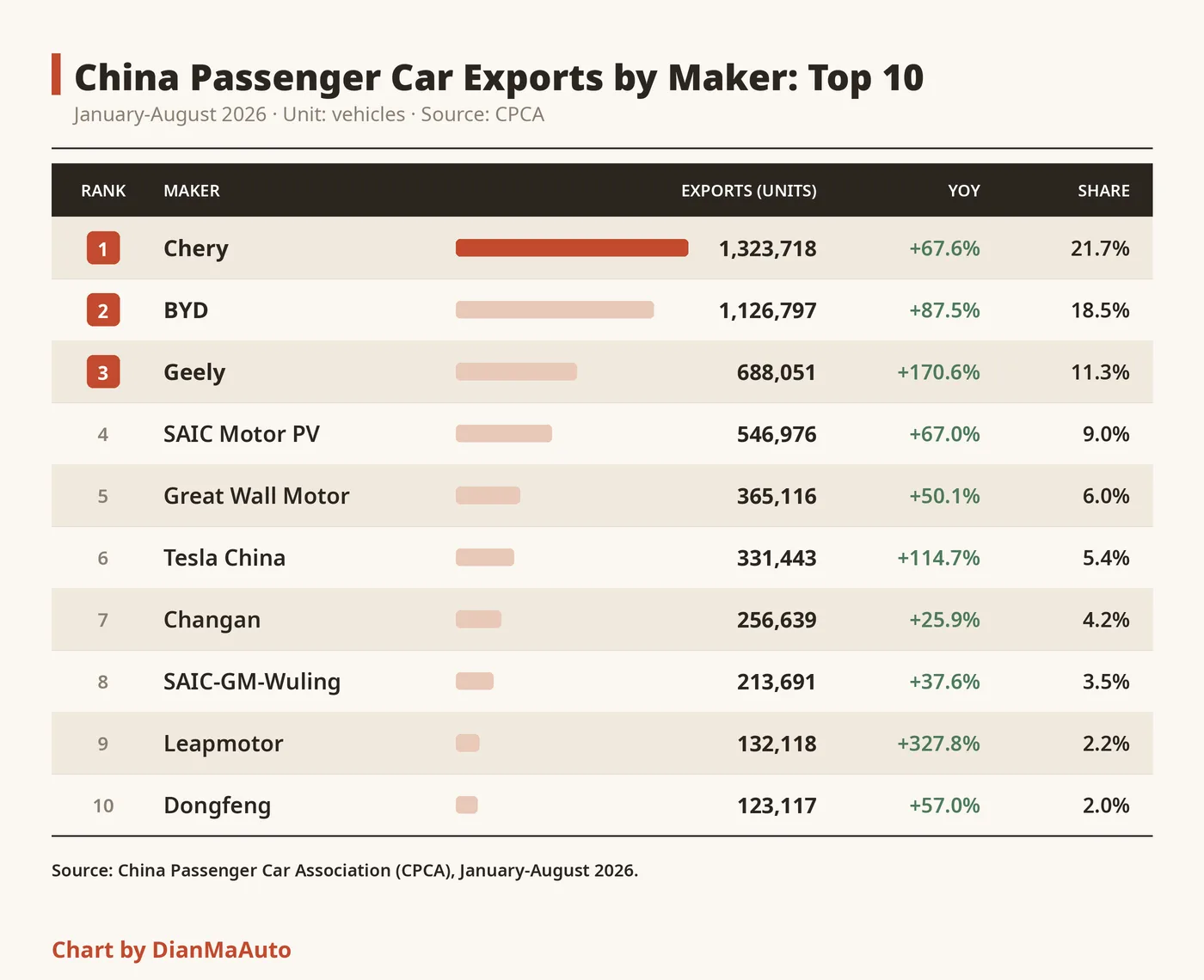
On automaker rankings, Chery leads while BYD is strongest in new energy. The overseas landscape for leading automakers has taken shape, and according to China Passenger Car Association (CPCA) data, the top 10 passenger car exports including overseas sales in January-August 2026 are as follows.
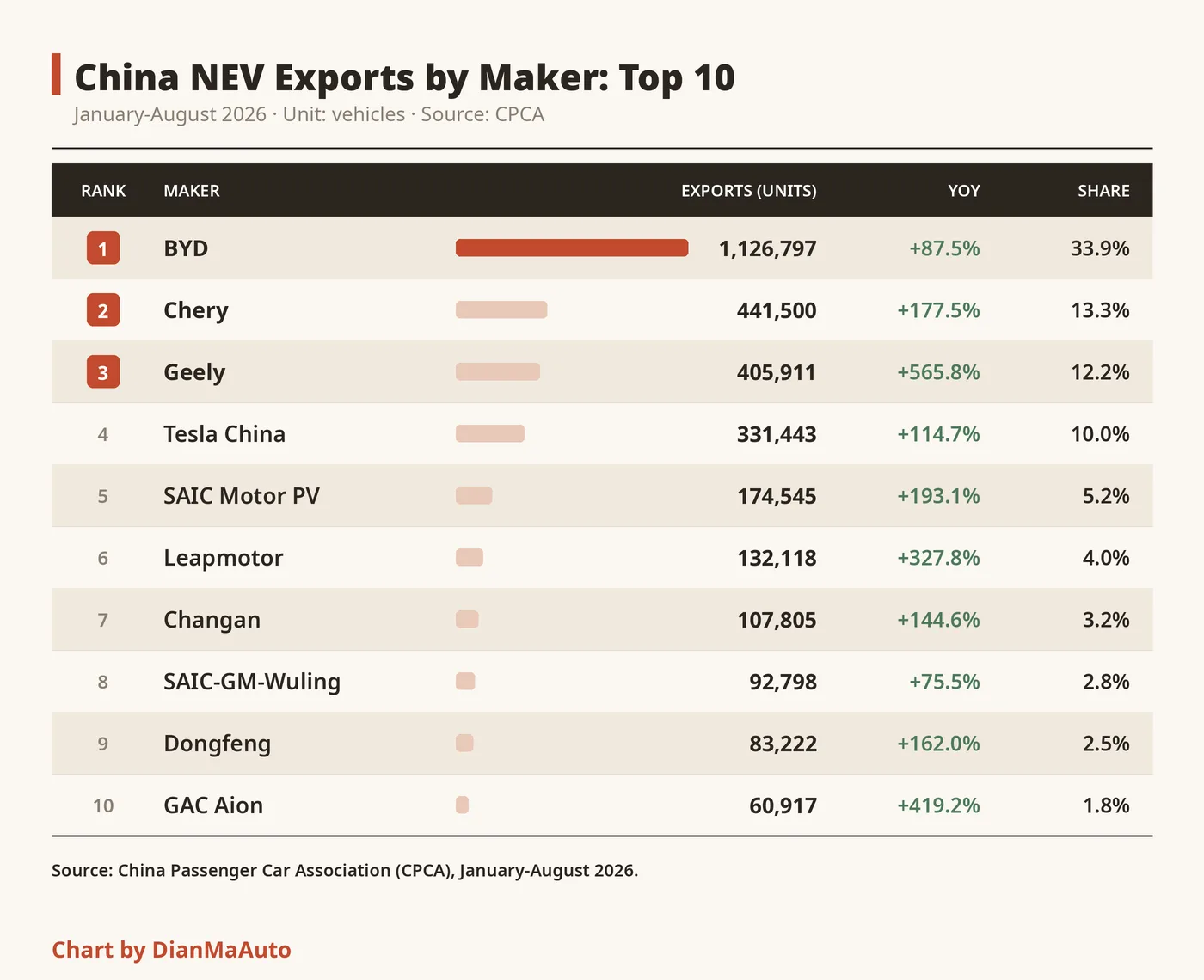
 Looking at the new-energy race alone, BYD leads with 1.1268 million units in January-August for a 33.9 percent share, almost a third of China's new-energy exports, followed by Chery at 441,500 units and Geely at 405,900, with Tesla China, SAIC Motor Passenger Vehicle, Leapmotor, Changan, SAIC-GM-Wuling, Dongfeng and GAC Aion filling out the top ten. Leapmotor grew 327.8 percent year on year and GAC Aion 419.2 percent, showing newer brands are filling the gap and exports are no longer a game only for traditional giants.
 As for hit models, Chinese brands took nine of the top ten overseas sellers in August, with the BYD Atto 2 topping the list at 44,670 units and the BYD Seagull second at 32,000, joined by the Chery Tiggo 7, Geely EX2 and Coolray. The only joint-venture model in the top three was the Tesla Model Y in third.
On destinations, Russia ranks first while Europe becomes the new increment. In terms of market structure, China's top ten vehicle export destinations in January-July 2026 were Russia, Brazil, the UK, Australia, Belgium, Mexico, the Philippines, Italy, the UAE and Algeria. Russia held first place with 542,800 units, up 143.4 percent, Brazil was second at 427,700, up 148.4 percent, and the UK third at 320,500, up 94.8 percent, the first time a developed market has entered China's export top three. Interestingly, Mexico fell to sixth from the top spot in 2025 under tariff policy while Russia retook the lead, showing how every geopolitical or tariff shift affects China's export map.
 Looking back at the history of China's auto exports, 2023 was the key watershed, when China overtook Japan for the first time with 4.91 million vehicles against Japan's 4.42 million to become the world's largest auto exporter. This year the gap between the two has widened completely, with data from the Japan Automobile Manufacturers Association (JAMA) showing Japan exported about 4.2 million vehicles in 2025 and 1.24 million in the first quarter of 2026, a monthly average of roughly 350,000 that keeps the full-year estimate around 4 million. China, by contrast, shipped 7.153 million in just eight months and could top 10 million for the full year, a figure that would leave Japan's 1985 peak of 6.8 million far behind.
From the automaker view, Toyota remains the global sales champion, but when it comes to selling to the whole world, China's BYD, Chery and SAIC have taken up the baton.
Still, Chinese automakers' overseas push is not without worries, with EU anti-subsidy tariffs, the de facto closure of the US market, data security reviews in some countries and long-term capability building in local operations, brand premium and service networks all posing challenges. But on the sales front, the foundation for Chinese automakers going global has been laid, and whether they can keep sprinting depends on whether they can complete a compliance leap in local operations, global compliance governance and global brand building.