BYD Just Topped a Global Self-Driving Benchmark With Its First-Ever AI Paper
By DianMa Auto · 2026-08-12 · Technology
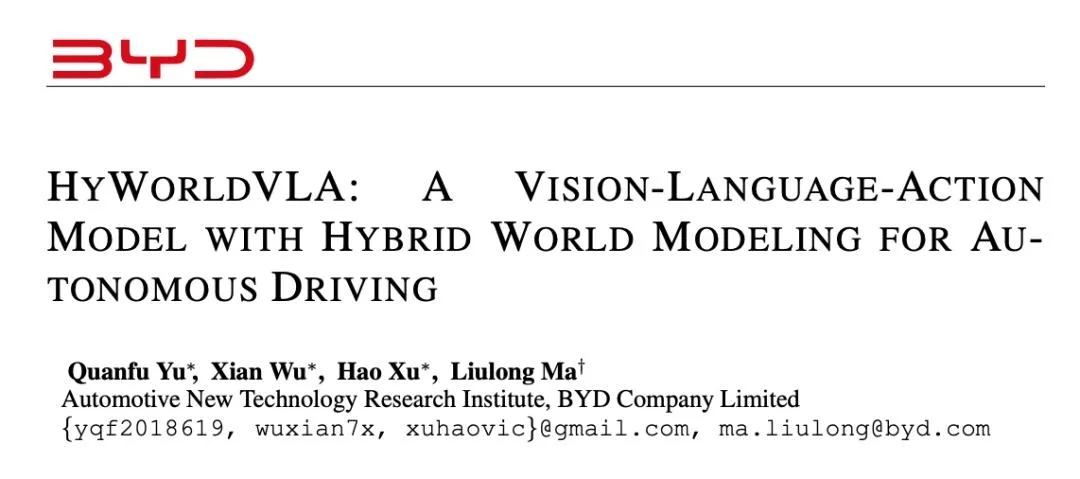
BYD is not the name you expect to see on an autonomous driving research leaderboard, which is exactly why this one raised eyebrows. The AI team at BYD's Automotive New Technology Research Institute published its first paper on July 29, introducing HyWorldVLA, a hybrid world model that pairs pixel-level and latent-space world modeling inside a vision-language-action architecture.
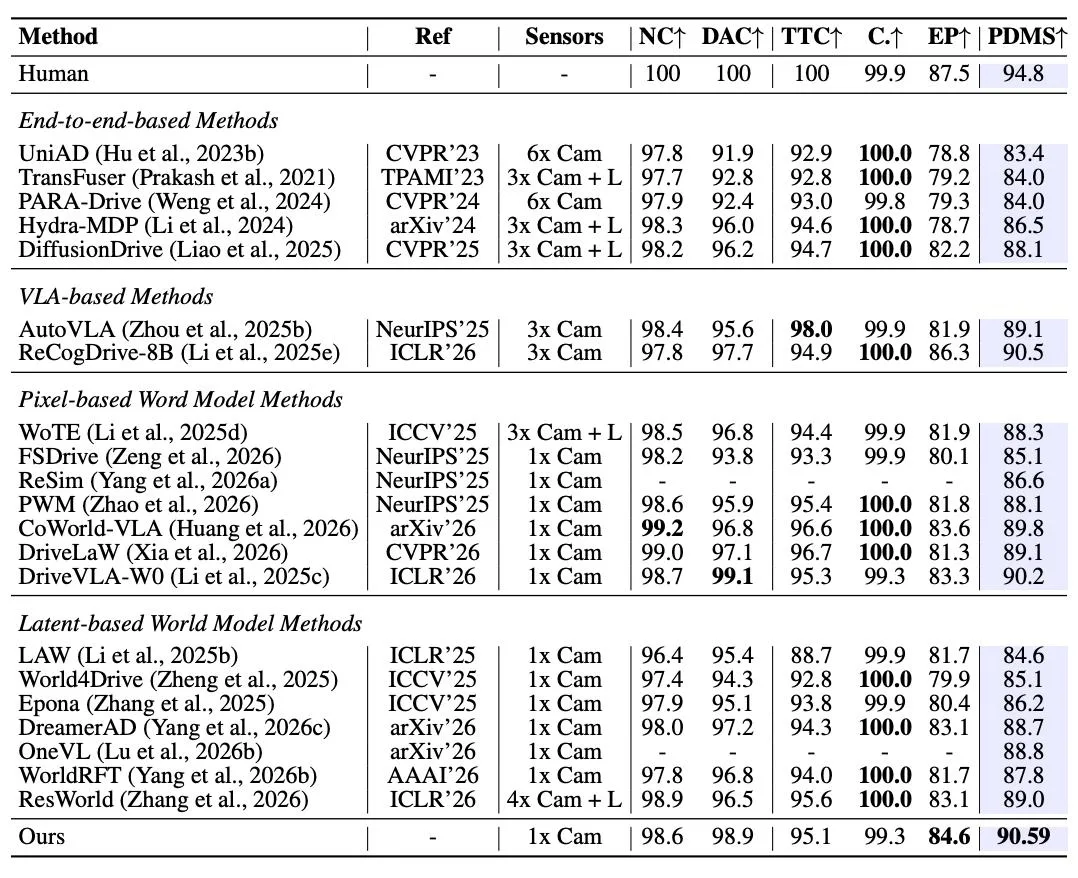
 It scored 90.59 PDMS on the public NAVSIM v1 benchmark, the best result on record.
 The model walks on two legs. Pixel-level world models predict future road scenes frame by frame like a movie, rich in detail but computationally expensive and easily confused by visual noise, while latent-space models run on compressed abstract representations that are efficient but tend to lose critical detail.
BYD's answer is to use pixel-level supervision as a watchdog during training, forcing the latent space to retain enough environmental information, then run inference on the lightweight latent model alone. Ablation tests show both halves earn their keep, with the score falling to 87.50 without pixel prediction and to 89.91 without latent processing.
NAVSIM is among the most watched public benchmarks in the field, and its PDMS metric does not simply reward prediction accuracy. It grades at-fault collisions, drivable area compliance, safe distance, goal completion and ride comfort, so a model cannot game it by crawling along or by being fast and reckless.
HyWorldVLA also scored 89.71 on the more comprehensive NAVSIM v2, nearly a point ahead of runner-up ExploreVLA, and hit 86.87 across 655 rainy and foggy noise scenarios, more than 19 points clear of the strongest baseline.
The result matters beyond the scoreboard, since BYD has long been typed as a manufacturing and supply-chain company whose smart driving story leaned on integration rather than original research.
Combined with its self-developed 4nm Xuanji A3 chip unveiled in May, rated at roughly 700 TOPS per chip and 2,100 TOPS in a three-chip setup, the company now claims a closed loop from silicon to algorithm.
That said, benchmark leadership is not production reality, simulation scores may not survive contact with real roads, and BYD has given no timeline for putting HyWorldVLA in a customer car.